
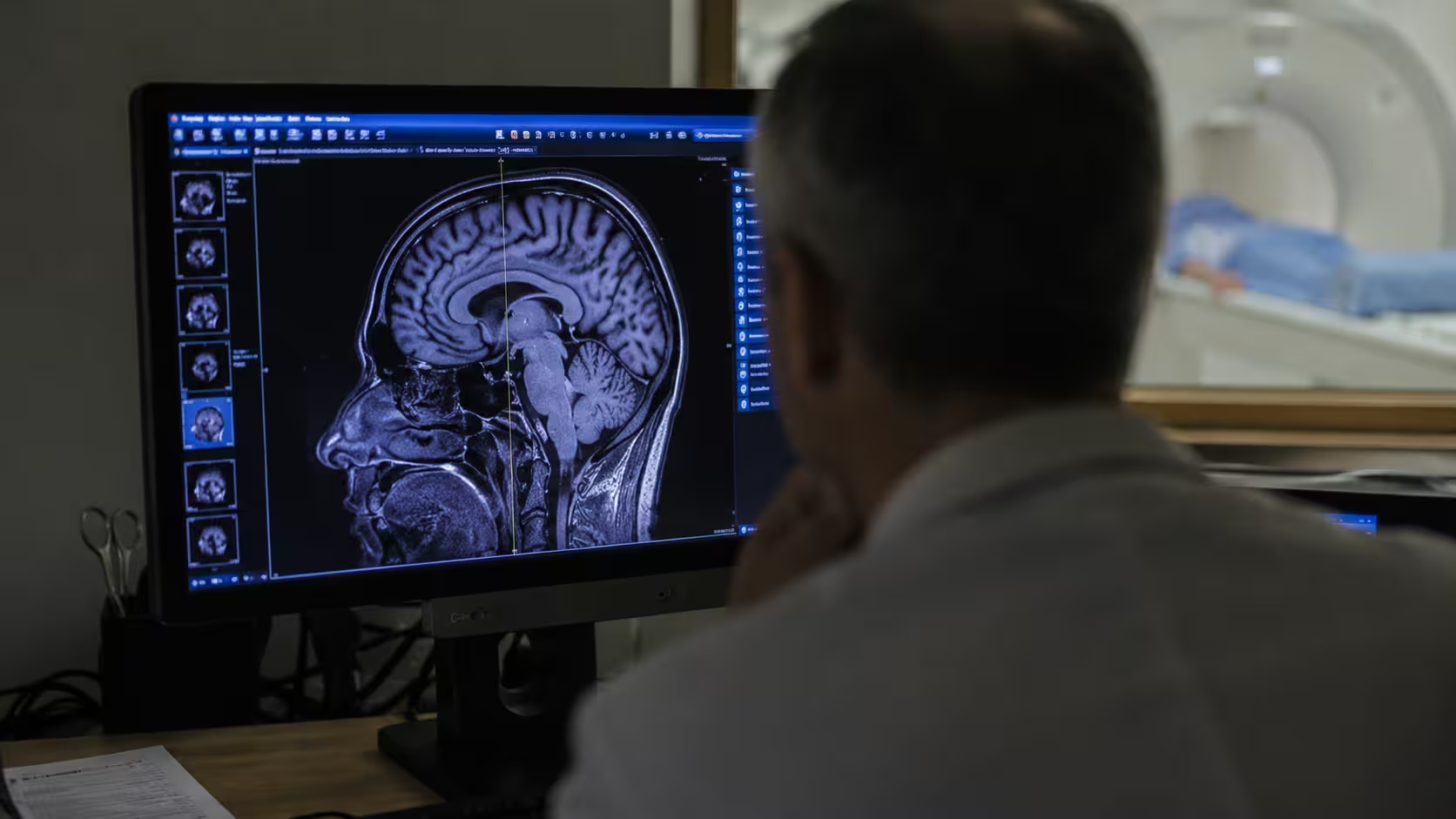
As artificial intelligence advances at remarkable speed, comparisons between computers and the human mind have become increasingly common. But a growing number of neuroscientists and philosophers argue that one of the biggest misconceptions of the AI era is the belief that the human brain functions like a machine.
The comparison has shaped decades of technological development. Early computing pioneers described the brain as biological hardware and the mind as software, suggesting that human intelligence could eventually be replicated through increasingly powerful machines. Today’s AI revolution has revived those ideas, with large language models often portrayed as digital versions of human thought.
Yet many researchers believe the analogy is fundamentally flawed.
Unlike machines, the human brain is not a fixed processor executing predefined instructions. It is a living organ shaped continuously by emotion, bodily experience, social interaction and biological change. Human thought emerges not simply from computation but from the dynamic relationship between the brain, the body and the surrounding environment.
Critics argue that reducing the mind to information processing overlooks essential aspects of human experience, including consciousness, intuition, imagination and subjective awareness.
Modern AI systems can analyze vast amounts of data, identify patterns and generate convincing responses. However, they do not possess lived experience. They have never felt fear, joy, grief or love. They do not develop identities through relationships or understand meaning through participation in the world.
This distinction has profound implications for how society understands intelligence.
The growing tendency to describe people as machines and machines as people risks distorting both neuroscience and public expectations of AI. Some experts warn that treating human cognition as merely computational may encourage workplaces and institutions to value measurable efficiency above creativity, empathy and judgment.
At the same time, anthropomorphizing AI can lead users to overestimate what these systems truly understand. Fluent conversation and human-like language may create the impression of reasoning or self-awareness when, in reality, today’s AI models generate outputs based on statistical relationships learned from data.
The debate also extends into education and healthcare. If human minds are viewed primarily as processing systems, learning and mental health interventions may become increasingly focused on optimization rather than recognizing the complexity of human development and emotional well-being.
Supporters of the computational view argue that neuroscience continues to uncover mechanisms underlying cognition and that future advances may eventually bridge the gap between biological and artificial intelligence. Others maintain that consciousness and subjective experience remain fundamentally different from machine processing.
As AI becomes more deeply embedded in daily life, the question is no longer purely academic. How societies define intelligence will influence the design of technologies, workplace expectations and the values guiding future innovation.
The remarkable capabilities of artificial intelligence have undoubtedly expanded the boundaries of what machines can do. But many researchers caution that humanity should resist the temptation to see itself merely as inefficient computers.
The human brain is extraordinary not because it calculates faster than machines, but because it weaves together memory, emotion, imagination and experience into something that remains uniquely human.
Reference: Financial Times, “The human brain is not a machine” (2026). Financial Times article