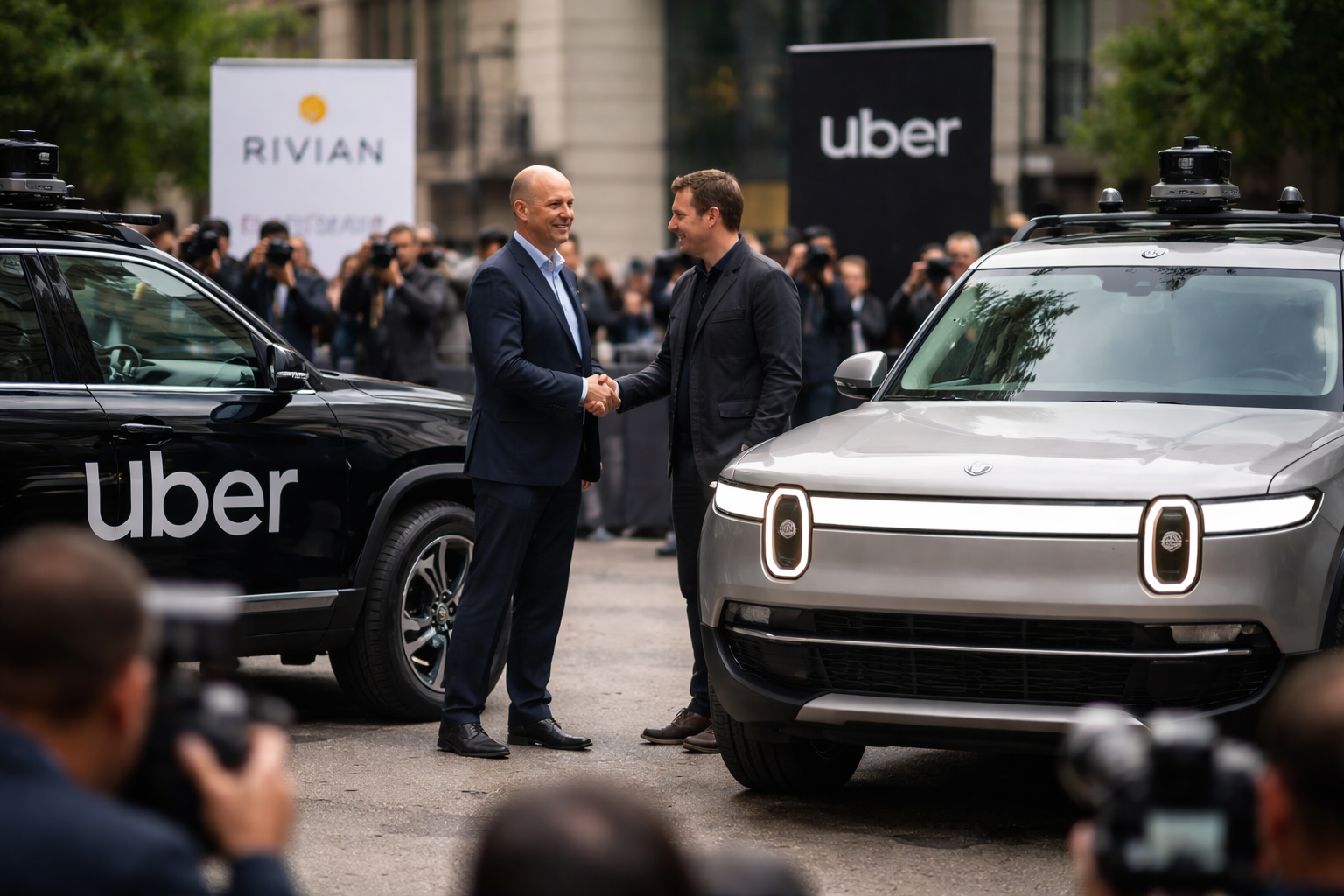
Uber Technologies has announced a major $1.25 billion partnership with Rivian Automotive to develop a new fleet of autonomous robotaxis, marking a significant step forward in the race toward driverless transportation.
A Strategic Push Into Autonomy
The agreement will see Rivian design and manufacture a dedicated fleet of electric vehicles tailored for autonomous ride-hailing services, while Uber will integrate the vehicles into its global platform. The partnership highlights Uber’s continued shift toward asset-light expansion while still investing heavily in next-generation mobility solutions.
Executives from both companies emphasized that the collaboration aims to accelerate the commercialization of robotaxis, combining Rivian’s electric vehicle expertise with Uber’s vast ride-hailing network.
Competing in the Robotaxi Race
The move places Uber more directly in competition with other players in the autonomous driving space, including Tesla and Waymo, both of which have been advancing their own driverless vehicle technologies.
Unlike earlier attempts to develop self-driving systems in-house, Uber has increasingly favored partnerships after selling its autonomous vehicle division in 2020. This latest deal signals a more focused approach — leveraging external innovation while maintaining platform dominance.
What the Deal Includes
Under the agreement:
- Rivian will produce a new line of electric vehicles optimized for autonomous driving.
- Uber will deploy and manage the fleet through its ride-hailing app.
- Both companies will collaborate with third-party autonomous technology providers.
While full technical details have not been disclosed, the companies suggested that pilot programs could begin in select cities within the next few years.
Market and Investor Reaction
The announcement has generated strong interest among investors, with analysts viewing the deal as a bold bet on the future of urban mobility. Shares in both companies saw positive momentum following the news, reflecting optimism about long-term growth opportunities in the autonomous vehicle sector.
However, some analysts remain cautious, noting that regulatory hurdles, safety concerns, and high development costs continue to pose significant challenges to widespread robotaxi adoption.
The Road Ahead
The partnership underscores a broader industry trend: the convergence of electric vehicles, artificial intelligence, and shared mobility. As cities evolve and demand for sustainable transport grows, robotaxi fleets are increasingly seen as a key part of the future transportation ecosystem.
For Uber, the deal represents another step toward reducing reliance on human drivers, while for Rivian, it opens a new revenue stream beyond consumer vehicle sales.
While timelines for large-scale deployment remain uncertain, the $1.25 billion investment signals that both companies are betting heavily on a driverless future — one that could reshape how people move in cities around the world.