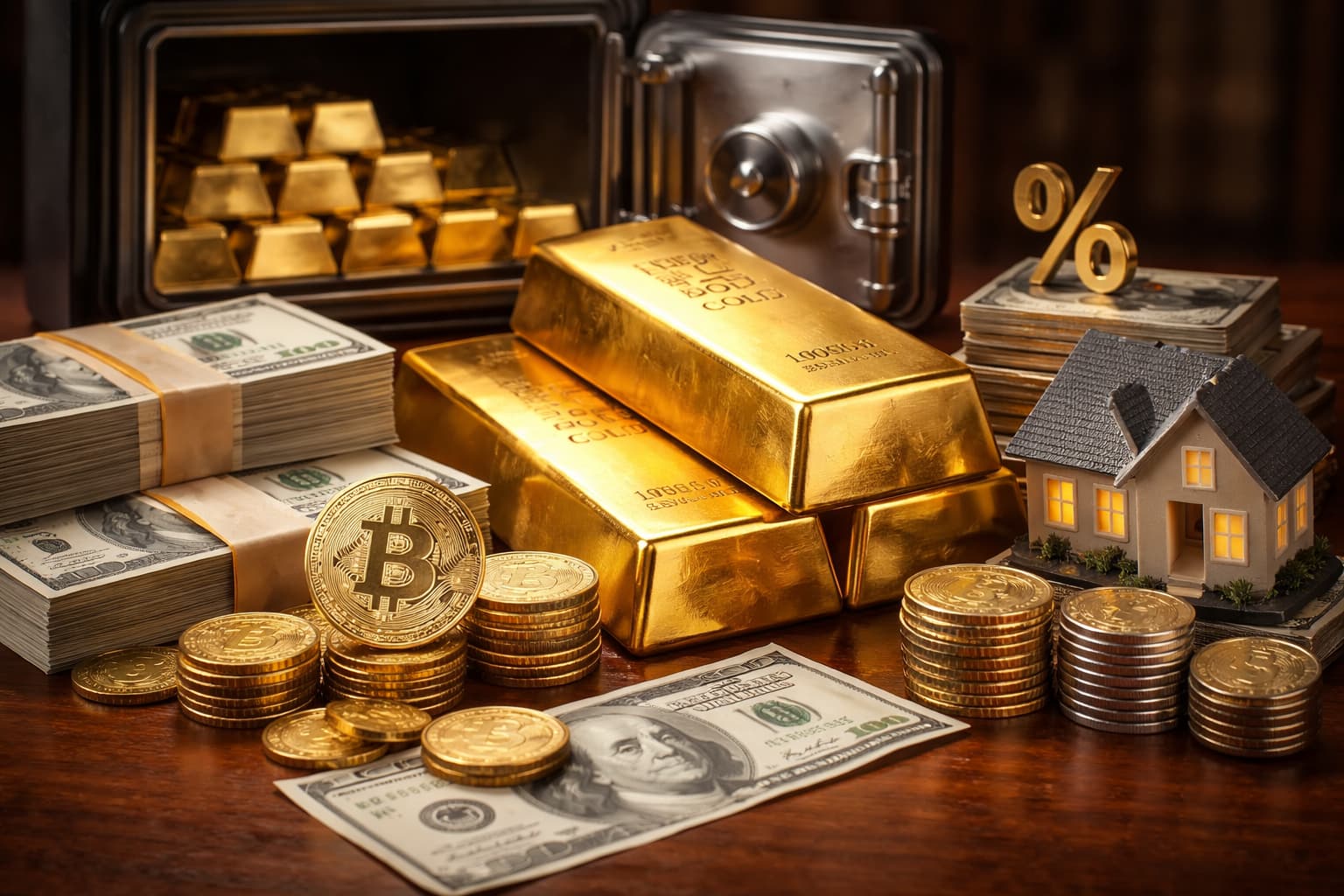
In a world of market uncertainty — driven by geopolitical tension, inflation pressures, and shifting central-bank policies — investors are again asking a fundamental question: Which assets are genuinely safe?
Recent market behavior shows that traditional notions of “safe haven” are being tested, and preferences among investors are evolving rapidly.
🟡 Gold: Still the Top Safe Haven
Gold has re-emerged as the preferred safe asset for many investors. Amid rising geopolitical tensions — particularly in the Middle East — gold prices have climbed sharply, with analysts reporting strong demand and record levels in 2026. Precious metals, including gold and silver, have outperformed many asset classes as investors seek stability amid uncertainty.
According to global market commentary, gold remains the leading refuge in times of stress, often outperforming traditional government bonds when inflation and political risk rise.
📉 Government Bonds: Not as Safe as Used to Be
For decades, government bonds — particularly U.S. Treasuries — were regarded as the ultimate safe haven. However, recent market shifts have blurred that status:
- Inflation concerns and rising yields have challenged the reliability of long-term government bonds.
- Investors have sometimes shunned bonds in favor of precious metals and defensive positions, especially when inflation erodes real returns.
This doesn’t mean bonds aren’t safe — but in the current environment, they may not always act as the stability anchor they once did.
💵 The Global Dollar and Currencies
Traditional safe-haven currencies like the U.S. dollar still benefit from liquidity and global reserve status. They often strengthen in times of market stress — but they don’t hold safe-asset status entirely on their own, especially when inflation and monetary policy come into play.
Some other currencies like the Swiss franc or Japanese yen have historically acted as havens, but their performance can vary depending on economic policy and interest-rate settings.
🪙 Silver and Other Alternatives
Silver has also captured investor interest this year, sometimes performing even stronger than gold in short stretches, as it combines safe-haven appeal with industrial demand.
Other alternatives — including defensive stocks, diversified funds, and certain commodities — can play roles in hedging risk, but they are not universally “safe” in all conditions.
📊 Risk vs. Safety: A Key Trade-Off
It’s important to remember that no asset is perfectly safe in every market. Instead, safe assets are defined by how they behave during stress and how they preserve capital relative to riskier holdings.
Experts emphasize that:
- Liquidity matters — a safe asset should be easy to buy and sell.
- Correlation matters — a true safe haven shouldn’t move in step with volatile markets.
- Purpose matters — sometimes investors prioritize preservation over return.
What This Means for Investors
Right now, many financial professionals recommend a diversified approach:
- Gold and precious metals for geopolitical hedge
- Selective bonds or short-duration fixed income for defensive balance
- Cash or high-liquidity instruments for stability
- Balanced portfolios that blend safety and growth potential
While equities and growth assets may drive returns in strong markets, true safe havens tend to emerge when volatility spikes or uncertainty dominates.
Bottom Line: As of early 2026, gold — often paired with silver — has taken center stage as the primary safe asset in turbulent conditions. Traditional safe havens like long-term government bonds and certain currencies still matter, but they are no longer as unconditionally “safe” as they once were. Investors are increasingly balancing protection and diversification in portfolio design.