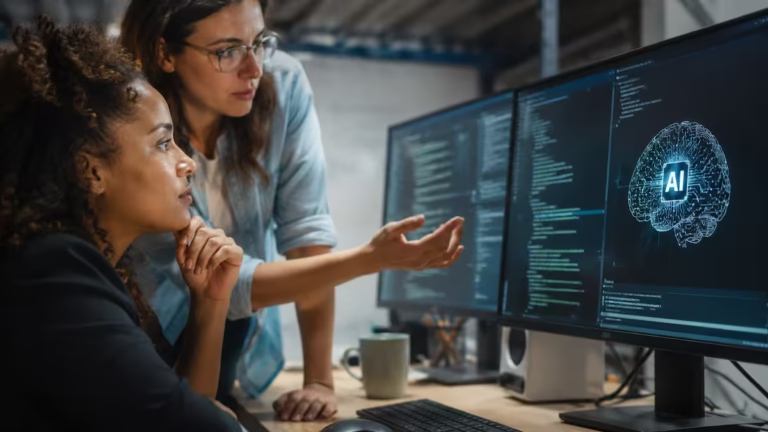

Artificial intelligence is transforming cybersecurity faster than almost any previous technological shift, reshaping both how attacks are carried out and how organizations defend themselves.
Security experts say the industry is entering an “AI versus AI” era, where attackers and defenders are increasingly deploying autonomous systems that operate at machine speed. The result is a cyber landscape that is becoming faster, more automated and significantly harder to control.
One of the biggest changes is the rise of AI-powered cyberattacks. Criminal groups are now using generative AI to create highly convincing phishing emails, automate vulnerability scanning and even modify malware in real time to evade detection. U.S. officials have warned that advanced AI tools could reduce the time needed to exploit software flaws from weeks to mere hours.
At the same time, companies are increasingly relying on AI for defense. Security teams are deploying AI-driven systems to detect unusual behavior, automate threat hunting and respond to attacks more quickly than human analysts alone could manage. According to the World Economic Forum’s Global Cybersecurity Outlook 2026, 94% of surveyed organizations expect AI to be the most significant driver of cybersecurity change in the coming year.
But the technology is also creating entirely new vulnerabilities. As businesses integrate AI agents into operations—from customer support to financial systems—security risks are expanding beyond traditional networks. Autonomous AI systems can gain access to sensitive data, interact with multiple tools and make decisions independently, increasing the potential damage if compromised.
Identity protection is emerging as a critical battleground. Cybersecurity firms report that attackers are increasingly targeting credentials, authentication tokens and cloud identities rather than simply breaching firewalls. In response, companies are moving toward stronger authentication methods such as passkeys and hardware security keys.
The growing threat environment is also forcing governments to rethink regulation. U.S. cybersecurity officials are reportedly considering dramatically shorter deadlines for fixing critical software vulnerabilities because AI-powered hacking tools can exploit weaknesses so quickly.
Meanwhile, organizations are becoming more concerned about AI-related data leaks than traditional hacking alone. The widespread use of generative AI tools inside workplaces has increased fears that sensitive corporate information could be exposed through poorly secured AI systems or employee misuse.
Experts say the industry is shifting away from a pure prevention mindset toward resilience and rapid recovery. As attacks become more sophisticated and automated, companies are focusing more on minimizing damage, detecting breaches faster and maintaining operational continuity during incidents.
Despite the risks, many analysts believe AI will ultimately strengthen cybersecurity overall—provided organizations adapt quickly enough. The challenge now is ensuring that defensive innovation keeps pace with the accelerating capabilities of attackers in an increasingly automated digital battlefield.